- Products
- Conformational Searching with CONFLEX
Conformational Searching with CONFLEX
This page summarizes the workflow introduced in Conformational Searching with CONFLEX, an article associated with Gaussian, Inc.'s book Exploring Chemistry with Electronic Structure Methods, Third Edition, describing how CONFLEX can be used in a conformational analysis workflow for NMR chemical shift prediction.

Study Objective
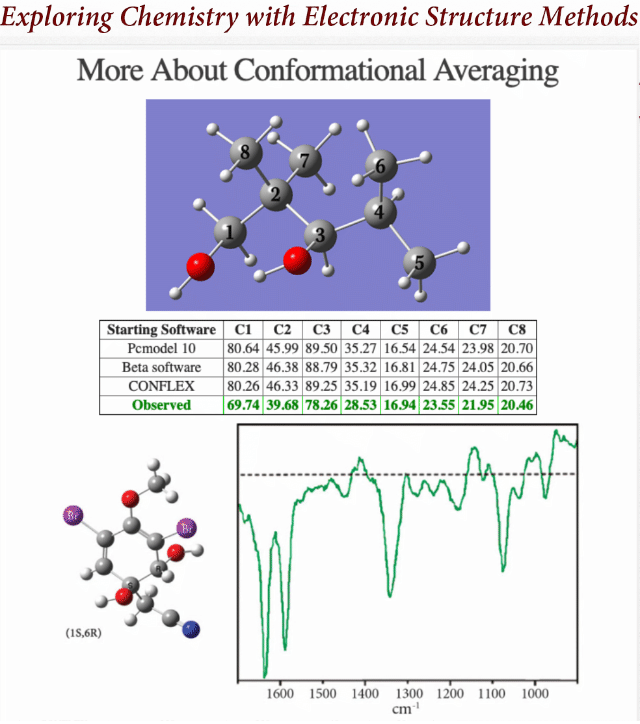
The example examines 2,2,4-trimethyl-1,3-pentanediol, a flexible molecule with multiple relevant conformations. Because the observed NMR spectrum reflects contributions from an ensemble of conformers, the calculation workflow first identifies meaningful structures and then evaluates their relative contributions before averaging the predicted chemical shifts.
Overall Workflow
- Run a CONFLEX conformational search to locate candidate structures.
- Optimize each conformation with Gaussian at the B3LYP/3-21G level.
- Remove duplicate optimized structures.
- Run Opt+Freq calculations on the remaining structures at the B3LYP/6-311+G(2d,p) level.
- Remove duplicates again and exclude conformers with negligible Boltzmann populations.
- Verify minima, run NMR calculations, and Boltzmann-average the predicted carbon chemical shifts.
Using CONFLEX for the Search
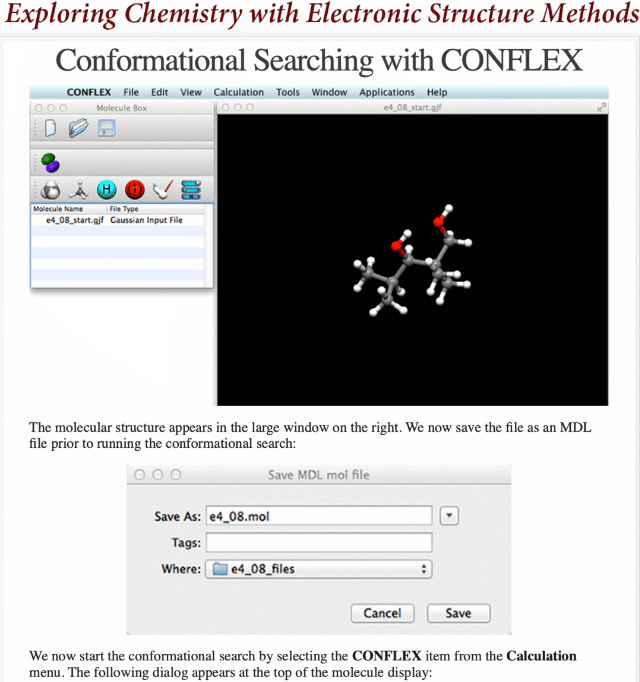
CONFLEX can open Gaussian input files directly, making it possible to start from the same structure used for the downstream Gaussian calculations. In the article, the initial Gaussian input is opened in CONFLEX and saved in MDL format before starting the conformational search.
The conformational search is launched from the Calculation menu. A key parameter is the Search Limit, which defines the allowed energy range from the lowest-energy conformation. A smaller range is useful when the goal is to find the most stable conformer, while a larger range is needed when the goal is to collect a broader conformational ensemble. For the example molecule, the article indicates that a few kcal/mol can be enough for locating the most stable structure, while a wider range is more appropriate for a fuller search.
Reviewing Search Results
CONFLEX reports conformers in an SDF results file and lists each structure with its estimated energy and Boltzmann contribution. The Conformers List can be used to inspect the search in more detail, including relative energy, Boltzmann population, and whether each conformer was used as an initial structure for additional search iterations.
The article notes that a fully exhaustive search is indicated when all conformers within the search limit have been used as initial structures. In the described calculation, the highest-energy conformers were already more than 10 kcal/mol above the minimum, so their influence on the final NMR average was expected to be negligible even though the search was not technically exhaustive at the upper end.
CONFLEX and Gaussian Integration
After the conformers are selected in CONFLEX, Gaussian jobs can be submitted from the Calculation menu. The article demonstrates using a saved calculation scheme for the first B3LYP/3-21G optimization step, then retrieving completed results from a remote server through the CONFLEX Job Manager.
The same approach is then extended to a second set of Opt+Freq calculations at a higher level of theory. Once unique, energetically meaningful conformers are identified and confirmed as minima, Gaussian NMR calculations are performed and the chemical shifts are averaged according to their Boltzmann weights.
Key Points
- Conformational analysis is important when predicted properties depend on multiple accessible molecular shapes.
- CONFLEX provides an automated way to search conformational space and examine the resulting conformer ensemble.
- The Search Limit balances completeness and calculation time.
- Duplicate removal and Boltzmann population filtering keep the quantum-chemical workflow focused on meaningful structures.
- Integration with Gaussian supports multi-step workflows from conformer search through optimization, frequency analysis, and NMR prediction.